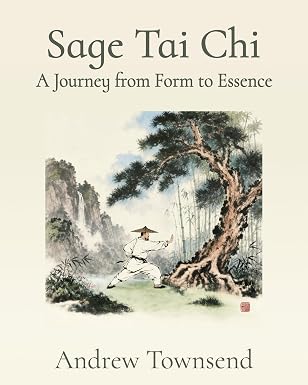
Sage Tai Chi: A Journey from Form to Essence by Andrew Townsend is an introspective examination of Taijiquan, designed to bridge the gap between external choreography and genuine internal cultivation. Written by a 13th-generation lineage holder in the Chen family system and 7th-duan practitioner, the book moves past step-by-step movement tutorials to tackle the philosophical and somatic core of the art.
Core Premise & Scope
The central thesis rests on a common dilemma in internal arts: many students memorize sequences (forms) but remain technicians, never accessing the essence—the inner stillness, structural integration, and energetic coherence that define true practice.
Townsend frames Taijiquan not as calisthenics or a stylized dance, but as an applied Taoist discipline for modern life. The structure traces a practitioner's full arc of cultivation:
-
Foundational Philosophy & Mindset: Cultivating the mind of a cultivator rather than a technician, framing movement through Taoist principles of non-striving (wu wei) and natural alignment.
-
Standing Practice (Zhan Zhuang): Establishing root, alignment, and release of chronic tension in stillness before setting the body in motion.
-
Form Work & Intent: Breathing life into solo forms by prioritizing yi (intention) and internal structure over outward aesthetic precision.
-
Complementary Pillars: Exploring weapons training, partner work/push hands (tuishou), conditioning, yangsheng (life-nourishing practices), and Qigong to round out the art.
-
The Living Teacher & Spiritual Maturation: Contextualizing lineage transmission, long-term self-correction, and the transition into lifelong internal discipline.
Key Strengths
-
Counterweight to "Calisthenic" Tai Chi: Most modern literature focuses heavily on 24-form choreography or general senior-wellness routines. Townsend focuses on how to practice—the internal levers of grounding, song (releasing tension), and mindful presence.
-
Systematic and Holistic: Rather than siloing the form as an isolated routine, the book connects standing, empty-hand forms, weapons, and restorative practices into a single coherent path.
-
Direct, Transparent Tone: Townsend is clear about his background and philosophy, and notably includes an honest disclosure regarding the use of AI tools in his creative/editorial process—an unusual level of authorial transparency.
Limitations & Considerations
-
Not a Movement Manual: Readers looking for pictorial walkthroughs or physical form diagrams will not find them here. It is an orienting companion for the mind and internal mechanics, meant to accompany practice rather than teach posture geometry from scratch.
-
Conceptual Depth Requires a Practice Base: While accessible, the text delivers its greatest value to practitioners who already have an established foundation (such as daily standing meditation, Qigong, or a solo routine) and need insight into unblocking stagnancy in their practice.
Verdict
Sage Tai Chi succeeds as a reflective guide for practitioners who feel stuck in repetitive mechanics and want to re-anchor their art in Taoist philosophy, energetic balance, and internal stillness. It serves best as contemplative reading alongside regular mat time rather than an introductory manual.